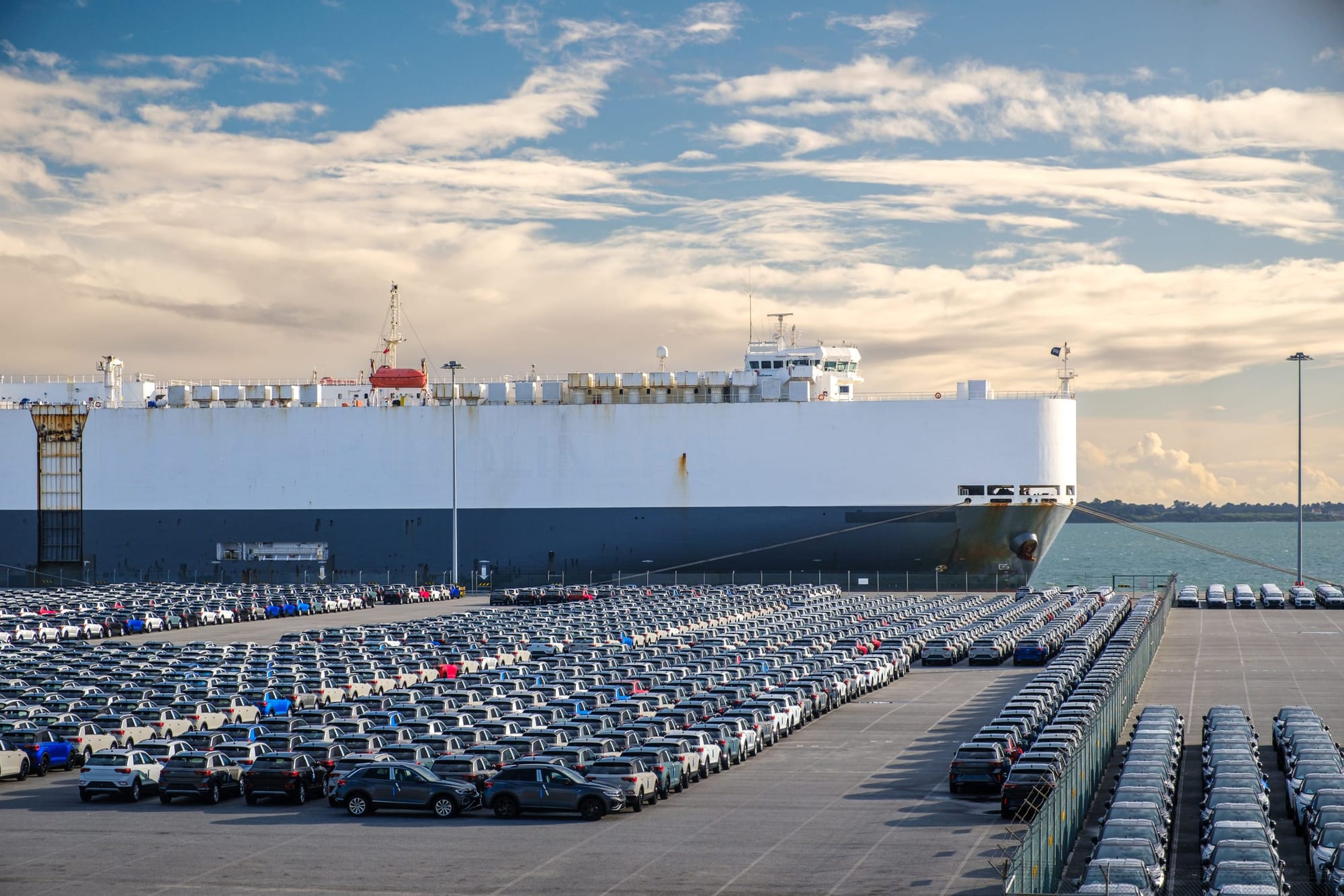
Importing a Car from the UK to Ireland
How a car gets from Great Britain onto Irish plates: the customs declaration, customs duty and Irish VAT, Vehicle Registration Tax, the NCTS deadlines and the documents to bring.
Who This Guide Is For
This guide is for buyers in Ireland who want a car from Great Britain, for people moving to Ireland who are bringing their own car, and for Irish motor dealers buying stock in Great Britain. It follows the car from the ferry to Irish plates. Routes, sailing dates and prices are on our Ireland shipping page.
Since 1 January 2021 Great Britain has been outside the EU for customs and VAT, so a car from Britain is an import into Ireland. It needs a customs declaration, with any customs duty and Irish VAT due at import, and then registration and Vehicle Registration Tax (VRT). Customs duty, Irish VAT and VRT are always paid by the importer. Cars bought in Northern Ireland are a different case, covered further down.
Step by Step After the Car Arrives
In this order. The first step starts before the car leaves Britain.
- 1
The customs declaration
The import declaration is made electronically in Revenue's Automated Import System (AIS). For a car booked as freight on a RoRo ferry, it has to be lodged before the car leaves for the ferry terminal in Britain: the ferry will not board a freight vehicle without a Pre-Boarding Notification listing its declaration. Most importers use a customs agent. To file it yourself you need Revenue Online Service (ROS), Customs and Excise registration and an EORI number; Revenue sets up the last two on request through MyEnquiries. The car's VIN must be on the declaration, because the NCTS uses it to check the declaration at registration.
- 2
Pay customs duty and Irish VAT
A private importer pays any duty and the import VAT through the declaration at the time of import. Deferred payment and postponed accounting are not open to private individuals. Keep the declaration's Master Reference Number (MRN): the car cannot be registered without the completed declaration.
- 3
Book the NCTS appointment within 7 days
The NCTS registers vehicles for Revenue. Book a VRT inspection within 7 days of the car entering the State, online, by phone or by post (NCTS VRT guidance). Until the car is registered, carry proof of the confirmed appointment whenever you use it.
- 4
Gather the documents
Use the checklist below. Revenue pays for one appointment only, so a second visit to fix missing paperwork is at your own expense.
- 5
Inspection and VRT, within 30 days
At the centre the car is checked against its documents, including the VIN, make, model and engine size, and Revenue works out the VRT, which you pay there. A tyre Environmental Management Cost charge also applies when a used import is first registered. Registration must be complete within 30 days of the car arriving.
- 6
Registration number and plates
Once the VRT is paid, the centre issues the Irish registration number. It must be displayed in the prescribed format within three days. You can buy the plates at the centre on the day.
- 7
Insurance and motor tax
You also receive form RF100 for motor tax. Insure the car first, then pay motor tax online at motortax.ie or at your local Motor Taxation Office. The Vehicle Registration Certificate then follows from the Department of Transport.
- 8
NCT, if the car is four years old or more
A car from Great Britain that is four years old or more is due its National Car Test from the date it is first registered in Ireland, so book the test once the car is registered.
Customs Duty and Proof of Origin
Duty is charged on the customs value: the price paid plus the cost of transport and insurance. For a car the rate is either 0% or 10%, and the deciding question is where the car was made, not where you bought it.
0% for a UK-originating car
A car that qualifies as originating in the UK under the EU-UK Trade and Cooperation Agreement can enter at 0%. It is not automatic: the preference has to be claimed on the import declaration.
10% for everything else
A car built in the EU, Japan or anywhere else normally pays 10%, however long it was used in Britain, unless a relief applies (see Returned Goods Relief). Revenue is explicit that an EU-built car in use in the UK does not qualify for the 0% rate.
How origin is shown
- A statement on origin. The exporter makes it out on an invoice or another document that identifies the car, based on information showing the car is originating, including where the materials used to make it came from. For an import into the EU it is valid for 12 months from the date it is made out.
- Importer's knowledge. The importer claims on the strength of information already held that demonstrates the car is originating. It has to be in hand before the claim is made.
- Not proof: the UK logbook. A UK registration is not proof of UK origin. Origin depends on where the car was manufactured and where its materials came from, and Revenue notes that it is generally certified by the manufacturer.
Keep the statement on origin, or the records behind an importer's knowledge claim, for at least three years after import. Revenue can check a claim after the car has been released. If 0% was not claimed at import, the agreement allows the claim to be made later, up to three years after the import, with the excess duty repaid, as long as the evidence exists. Private sellers and many used-car dealers cannot issue a valid statement on origin, so we look at the evidence for a specific car with you before you commit.
Revenue's own worked example, with no relief: a purchase price of €32,000 plus €500 transport gives a customs value of €32,500. Duty at 10% is €3,250. VAT at 23% is then charged on €35,750, which is €8,223. VRT comes on top at registration.
Irish VAT on Import
A car from Great Britain pays Irish VAT at import at the standard rate, currently 23%. It is charged on the customs value plus any customs duty, so the duty is taxed too.
- Private importers pay it through the customs declaration at import, before the car can be registered.
- VAT-registered Irish dealers can pay it at import and reclaim it on the next VAT return, use a deferred payment account if authorised, or use postponed accounting to account for it on the return. Under postponed accounting, customs duty is still paid at import. On resale, VAT is charged on the full selling price excluding VRT: a car imported from Great Britain cannot be sold under the margin scheme.
- New cars, meaning six months old or less, or driven 6,000 km or less, pay VAT at import and no further VAT at registration.
UK VAT does not reduce it. Revenue has said that UK VAT charged on a used car has no bearing on the VAT due when the car is imported. That is why a VAT-qualifying car that a VAT-registered UK dealer can sell free of UK VAT for export is worth looking for: see our tax-free vehicle supply page. We are not VAT registered, so that saving comes off the dealer's price.
Vehicle Registration Tax and the NOx Levy
VRT is paid when the car is registered and is usually the largest single charge. For a car it has two parts, added together.
- A CO2 charge. A percentage of the car's Open Market Selling Price (OMSP), set by its CO2 band, with a minimum amount in each band. In 2026 the rates run from 7% for 50 g/km or less to 41% above 190 g/km. A car with no satisfactory CO2 evidence is charged at the top rate.
- A NOx levy. Charged per mg/km of nitrogen oxides on a rising scale, on petrol, diesel and hybrid cars but not fully electric ones. The figure is recorded on the certificate of conformity. Without satisfactory NOx evidence Revenue applies a default, currently €4,850 for a diesel and €600 for any other car. In one of Revenue's worked examples, a diesel hatchback with no NOx evidence pays the €4,850 default on top of a CO2 charge of about €2,100.
The OMSP is Revenue's figure, not your price
The OMSP is Revenue's own valuation of the car, and it usually differs from the invoice. Revenue sets it from UK and Irish trade guides, advertisements and expert advice. Poor condition or unusually high mileage can bring it down. Revenue's online VRT calculator gives an estimate for cars in its database; the exact figure is fixed when the car is presented for registration.
Older UK cars with an NEDC figure. Many used cars were tested under the older NEDC cycle. Revenue converts an NEDC CO2 figure with a formula before banding it, and the conversion raises the figure, so a car can land in a higher band than the CO2 figure on its V5C suggests.
Classic and electric cars
A vehicle more than 30 years old at the time of registration pays a flat €200 instead of the CO2 charge and NOx levy.
Fully electric cars get VRT relief of up to €5,000, applied automatically at registration and never more than the VRT due. Full relief applies up to an OMSP of €40,000, it is reduced between €40,000 and €50,000, and there is none above €50,000. Hybrids and plug-in hybrids do not qualify: the relief is for cars powered only by an electric motor.
Budget 2027. Revenue's current guidance gives the electric car relief only to cars registered before 31 December 2026. Budget 2027, announced on 6 October 2026, extends it to 31 December 2028, and announces a 1% increase in VRT rates for cars in bands 3 to 20 (above 80 g/km) from 1 January 2027. Budget measures need legislation and can change before it is passed, so check Revenue's figures for the date you will register. Revenue: calculating VRT.
NCTS Deadlines and Registration
There are two deadlines, and both run from the day the car enters the State.
7 days to book
The VRT appointment must be booked within 7 days of the car entering the State. This is the one people miss.
30 days to register
After 30 days Revenue adds 0.1% of the VRT due for every day the car has been unregistered, counted from the day it first entered the State.
A car that needed a customs declaration and has none, or that is not registered within 30 days of arriving, can be seized. Driving an unregistered car is an offence. The NCTS asks you to carry proof of the confirmed appointment whenever you use the car, until it is registered and the Irish number is displayed.
If you register the car yourself, booking is up to you. Revenue's page on registering a vehicle bought in Great Britain and the NCTS VRT guidance are the places to check before the appointment.
Cars Bought in Northern Ireland
Under the Windsor Framework there are no customs formalities on goods moving between Northern Ireland and Ireland. A used car bought in Northern Ireland can be registered on payment of VRT alone, with no customs duty or import VAT, if either:
- it was imported into Northern Ireland in line with the Windsor Framework, shown by the Northern Ireland import declaration, or
- it was in Northern Ireland before 1 January 2021 and has stayed there.
Where the seller was not the original importer and the declaration is not available, Revenue may, at its discretion, accept other proof. As a minimum it wants the original V5C issued to the last registered keeper, showing that they are resident in Northern Ireland, a Northern Ireland service history and, where the car needs an MOT, a Northern Ireland MOT history. Revenue does not approve vehicles or paperwork in advance, so have the evidence before you buy. Without it, the car is treated as a direct import from Great Britain.
A car from Great Britain that travels through Northern Ireland is a Great Britain import too, unless the import formalities were completed in Northern Ireland and that declaration is produced at registration. A new car bought in Northern Ireland, six months old or less or driven 6,000 km or less, is liable to Irish VAT, normally paid at registration.
Reliefs: Moving to Ireland, and Returned Goods
Transfer of Residence
If you are moving your home to Ireland, your own car can come in free of customs duty, import VAT and VRT if you meet Revenue's conditions. The main ones are:
- You owned the car and used it yourself for at least six months before the move. Use in Ireland does not count.
- For VRT relief, your normal residence was abroad: generally where you live for at least 185 days a year because of work and personal ties.
- For relief from customs duty and VAT, you lived outside the EU for at least 12 months in a row before the move.
- The car was tax and duty paid where you bought it, and it comes in within 12 months of the move.
- You keep it for 12 months: selling or disposing of it sooner makes the relieved tax payable.
Apply in good time. When household goods come too, email form C&E 1076 (Rev 2) and the supporting documents to Revenue at your port of entry two weeks before they arrive, and ask for a Pre-Boarding Notification ID if the goods travel on a freight ferry. A car arriving by ferry on its own is claimed on form VRT TOR, through MyEnquiries where possible. Revenue asks for the VRT claim within seven days of the car arriving, and the car must still be registered within 30 days. If it is registered before the claim is decided, you pay the VRT and Revenue refunds it within five working days of granting relief. Revenue: Transfer of Residence.
Returned Goods Relief: rarely available
Returned Goods Relief removes customs duty on goods that were exported from the EU and come back. It has nothing to do with where the car was built. The car must have been exported from the EU, must come back unaltered, and must be re-imported within three years of that export, longer only in special circumstances. Proof of the original export, such as the export declaration, is needed, and the relief is claimed on the import declaration. Import VAT is still payable: relief from VAT is possible only in very specific cases where the person re-importing the car is the person who exported it.
Why it seldom helps: cars that moved to Britain before 2021 are now outside the three-year window, so the relief only reaches a car exported from the EU within roughly the last three years. It is not a general route around the 10% on ordinary UK used-car stock.
Documents Checklist
Take originals to the NCTS appointment, and keep copies: the centre keeps the original foreign registration certificate.
- The UK V5C logbook. Without it, registration is refused. The UK keeper sends only the permanent export section to DVLA and keeps the rest, which is needed to register the car abroad.
- The customs declaration: a copy showing the MRN, and the item number that lists the car's VIN.
- Evidence of the arrival date, such as shipping details or travel documents.
- The purchase invoice, showing the date of purchase. If it is more than 30 days old, evidence of where the car was stored outside the State may be asked for.
- The Vehicle Purchase Details form, completed in full: VRTVPD2 for a private buyer, VRTVPD1 for an authorised motor trader.
- Evidence of the CO2 and NOx figures at manufacture, such as the certificate of conformity.
- Photo ID: a passport or driving licence.
- Proof of name and address: a hard-copy utility bill or bank statement no more than six months old, or two online statements from different providers, one of them a bank statement.
- Your PPS number, with official documentary evidence of it.
Where they apply
- The statement on origin, or your origin records, if 0% duty was claimed. Keep them for at least three years.
- For a car from Northern Ireland, the Northern Ireland import declaration, or the V5C, service history and MOT history described above.
- For Transfer of Residence, Revenue's VRT exemption notification.
- To register a car for someone else, a signed letter of authority and that person's ID.
How We Help
We handle the UK side. Our price for Ireland covers loading and lashing the car, UK customs export and clearance, UK port handling charges, DVLA documentation and export certification, the export paperwork including the Bill of Lading, and the crossing itself.
- Finding or buying the car. We source cars from UK dealers, auctions and private sellers, or buy one you have found on your behalf.
- Checking the numbers first. Before you commit, we look at whether the car can be shown to be UK-originating and estimate its VRT on the current figures, because duty and VRT change what the car really costs.
- VAT-qualifying cars. We find cars that VAT-registered dealers can sell free of UK VAT for export, and give the dealer the proof of export it needs. We are not VAT registered, so the saving comes from the dealer.
- The Irish side, if you want it. We can arrange customs clearance, registration and delivery to your door in Ireland through a local agent, quoted separately, or work with an agent of your choice.
Customs duty, Irish VAT and VRT are always payable by the importer and are never part of our price. Routes from Holyhead and Fishguard to Dublin and Rosslare, sailing dates and prices are on our Ireland shipping page.
On This Page
Bringing a Car to Ireland?
Get a quote for the UK side, with Irish clearance and registration quoted separately if you want them.
Get QuoteImporting a Car to Ireland: FAQs
Common questions about bringing a car from the UK into Ireland.
Do I pay customs duty on a car imported from the UK to Ireland?
It depends on where the car was made, not where you bought it. A car that qualifies as UK-originating under the EU-UK Trade and Cooperation Agreement can come in at 0%, but only if that is claimed on the customs declaration, backed by a statement on origin from the exporter or by importer's knowledge. Otherwise the car normally pays 10% of the customs value, including an EU-built car that has been in use in Britain, unless a relief such as Returned Goods Relief applies. A UK registration document is not proof of origin.
Is Irish VAT charged on a used car from Great Britain?
Yes. Irish VAT at the standard rate, currently 23%, is charged at import on the customs value plus any customs duty. A private importer pays it through the customs declaration, and the car cannot be registered until the declaration is done. It is due even if UK VAT was included in the price paid in Britain.
How long do I have to register a car brought in from the UK?
Two deadlines run from the day the car enters the State. You must book a VRT appointment with the NCTS within 7 days and complete registration within 30 days. After 30 days Revenue adds 0.1% of the VRT due for every day the car has been unregistered, counted from the day it arrived, and a car that is not declared to customs or registered in time can be seized.
How is VRT worked out on a car imported from the UK?
For a car, VRT is a CO2 charge plus a NOx levy. The CO2 charge is a percentage of Revenue's Open Market Selling Price for the car, set by its CO2 band, so the price you paid in Britain does not decide it. The NOx levy is charged per mg/km, and if you cannot show the NOx figure Revenue applies a default that is much higher for a diesel. Cars more than 30 years old pay a flat charge, and fully electric cars get relief of up to €5,000.
Can I bring my own car to Ireland tax-free when I move there?
Possibly, under Transfer of Residence relief. You must have owned and used the car yourself for at least six months before the move, have had your normal residence abroad, bring the car in within 12 months of moving and keep it for 12 months after registration. Relief from customs duty and VAT also needs at least 12 months living outside the EU. Apply to Revenue in good time: Revenue asks for the claim within seven days of the car arriving. The car must still be registered within 30 days.
Are Irish duty, VAT and VRT included in your price?
No. Our price covers the UK side and the crossing. Customs duty, Irish VAT and VRT are always payable by the importer. We can arrange customs clearance, registration and delivery in Ireland through a local agent, quoted separately, or work with an agent of your choice.
Talk It Through with an Export Specialist
Tell us about the car and where in Ireland it is going. We will quote the UK side and, if you want it, the Irish clearance and registration through a local agent.